Monday, November 23, 2015

Frost country


We've settled in now. We have a clear weekday routine in the household, with an early start: Bruce takes me to the bus stop on Route 7 at 6.45am on the days I'm working at UVM, the girls are out of the house by 7.10am. Bruce luxuriates in 8 or 9 hours of peaceful work, accompanied only by the birds and assorted wildlife in the back garden, until the girls tumble out of the bus at around 3.40pm, and then he comes up to Route 7 to pick me up from the bus at 5.30pm.
 
I've had two fruitful weeks at work: it's exciting to see the results of my research put into action in a new context. The opening lecture was well attended, and workshops have been going well - lots of enthusiasm, lots of discussion about writing and science, and now we are starting the meetings about where to go next with this material.

The weather so far has been unseasonably mild and clear (to the frustration of our energetic friends who are polishing their skis and willing the forecast to signal that snow is on its way). Saturday was the first morning since we've been here that we've woken up to temperatures firmly below zero. We set off in search of a dead poet early in the morning under a clear washed-pink sky and fields frosted (appropriately) in white.  

Robert Frost is one of my favourite poets. My very first English assignment at university had a Robert Frost poem as its subject, and I've read many of his poems so often that they're almost part of the way I think. Last time we were here, we visited his country cabin in Ripton and walked the trails that inspired much of his poetry. This time we were heading to Bennington, for his grave, and for the house he lived in from 1920-1929, where he wrote some of his most famous poems, including my favourite, "Stopping by woods on a snowy evening".

 
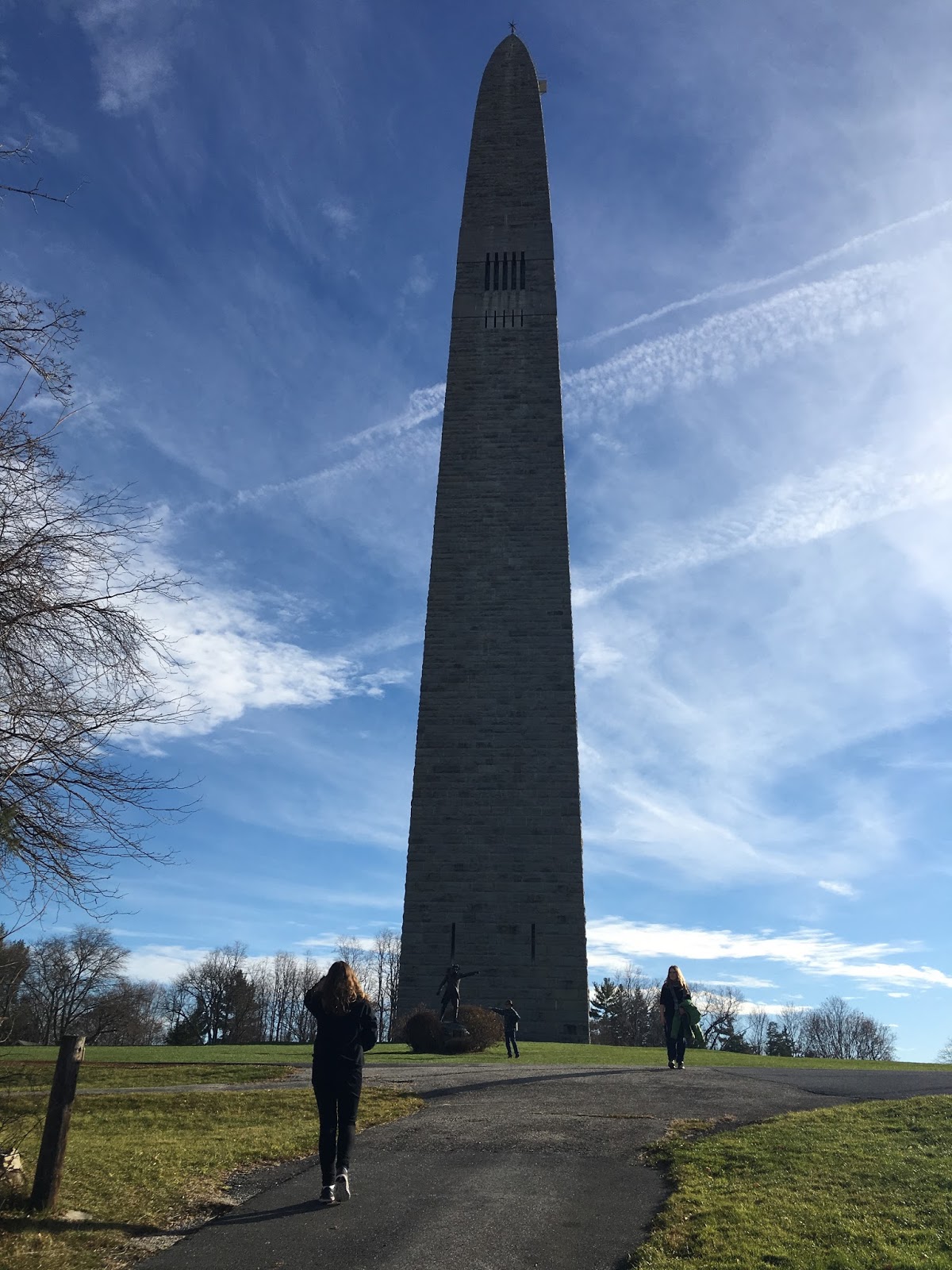
 Overshadowing Bennington is a giant phallic symbol...uhum, did I say that out loud? - sorry, obelisk on the top of a hill. The Bennington Battle Monument commemorates the Battle of Bennington, a hard-won fight in the War of Independence:  set amongst beautiful, historic, colonial mansions, the monument casts its shadow over the humble homes in the valley. Bennington seems an unlikely place to be be held in thrall by so much testosterone: it is a small, quiet town which feels weighted down by its history. 


We found Robert Frost's grave in the lovely cemetery of the Old First Congregational Church.


The grave was in a quiet place, and fringed with nickels placed by visitors. So, as well as adding nickels of my own, I left a New Zealand coin to say that we'd been there.


We enjoyed Bennington: the locals were friendly, and there was a lot to do in such a small town. We ate in laid-back cafes which served locally grown food and were furnished with old, squashy sofas.


 We visited two amazing chocolate shops.
 
Emily wishes to consume the chocolate moose


So much to choose from!! Chocolate turkeys anyone? Salted caramel chocolate snowmobiles? Curried chicken cashews??

We visited the Bennington museum, which hosted a collection of Grandma Moses paintings...

This was my favourite, named "The sugaring".
 I asked Bruce as we walked around the gallery if he liked them and he said "Not at first - I thought they were too Christmas-cardy, but then you look closely and they're so full of life." And that's what I love about her paintings too: the way they portray the energy of a community life.

The museum was guarded outside by (don't blame me, it's the testosterone) a rather iffy "Spirit of America". Hmmm. Really?


We drove through three beautiful covered bridges.
 

Finally, we made our way to Robert Frost's house outside Shaftsbury.


Something there is that doesn't love a wall (thanks, Jerry!)
 We couldn't go inside - like everywhere else now, it is "closed for the season," but to sit on the stone walls and look out at the birch and apple trees, all features of Frost's poems, was all pleasure.

How many times in this blog have I returned to this theme of "the road not taken"? But let's not go there today. Let's simply say that this was such a satisfying day, walking through a sleepy old town full of ancient memories of battles and glory, and poetry.


Sunday, November 15, 2015

Far over the misty mountains old


When we were planning to come back to Vermont,  we had some concerns: was it wise to go back to a place we had loved so deeply? What if our memories had cast that infamous rosy glow on our time here? Was it like trying to step back in time?


And indeed, the first few days here were like stepping back into a memory. It was late fall. The maple leaves had fallen, but the gold-brown leaves clung to the oak trees, and the willows had not yet turned.


As we walked through the forest at Mount Philo, we watched golden leaves hang and drift through sunlit misty air. "Why, oh why didn't we come three weeks earlier?" we asked one another every day in that first week or so. But it was all exactly as I had remembered it, my favourite time of the year in Vermont.


The sense of unreality was undoubtedly exacerbated by the fact that we had visited Hogwarts on the way here.


All aboard the Hogwarts Express!


In 30 degrees heat, children and adults were dressed formally (long pants, long-sleeved shirt, house tie, covered shoes and socks, wool-lined cape with a house crest) for dinner in Hogwarts Great Hall, buying wands from Olivanders, and and chattering about Quidditch. In those strange two days, what was real seemed to slip away - on the way to the hotel, our cab driver seemed equally mystified by both our destination ("Vermont? Where's that? Canada, is it?") and our point of departure ("New what? New Zealand? That's in Scotland, right, by your accent?").  I found myself trying to explain the basic principles of rugby to him: "So, it's like softball, right?" he said when I'd come to a stammering halt.  No. No, it really isn't.

Speaking of rugby, this family of kiwis got their priorities right at Disneyworld....a friend of Em's was live-streaming the game by holding her phone out to the TV

Celebrating a great All Black victory!

After a few days, the intense yet hazy sense of dislocation passed, as it does. But still there persists a remnant of that feeling that time and space are not operating in predictable ways. We are back in the cottage by the lake, looking across to the shadowy Adirondack mountains. Our first days were about reacquainting ourselves with the people (and dogs) in this community and catching up on their news, taking familiar walks, visiting our favourite places (Dakon Farms and the Flannel Shop were high on the list). Lizzy went back to her old school and rejoiced to be back with old friends. We picked up our old car. On Sunday we went back to Trinity Church and it was truly lovely to be welcomed back by old friends. And then back to UVM, and to my dear friends in WID, and it really felt as I'd stepped back into a loved, alternative life that had been simply running alongside my New Zealand life all along.


OK, alright - yes, I agree - I've watched way too much Star Trek and Dr Who in my time. And yes,  Bruce and the girls always smile indulgently at me when we're watching one of these programmes and someone says "You can't mess with the space-time continuum" and I sigh a happy sigh. And yet, and yet... "how's life in the future?" I hear Em saying to her friends in NZ.

Image result for picard Space time continuum

Nevertheless, among all that is familiar and constant, time and memories have made changes. The Spinones of Long Point, Broli and Falco, are smaller than we remember them now that we have one of our own.  Our neighbour by the lake is negotiating a new relationship. There are a few unfamiliar faces in the WID department. The girls' friendship groups have kaleidoscoped into new patterns. Most vivid (and joyous) of all was a change that met me as we walked into Trinity Church. Two years ago, a young couple sat on the front pew, sobbing through every service, the wife frail, pregnant and dangerously ill and having to make the kinds of decisions you'd pray no-one ever had to make. As we walked through the doors of the church, two little girls with strawberry blonde hair were dashing around the foyer, and their father greeted us with an open  smile I'd never dreamed of seeing on his face. I watched for the next hour how the community held and nurtured this family - how different people played with the twins, carried them out of the church for the sermon, held them on their hips as they walked to communion so their parents could have a rest. This community had prayed for a miracle, and now they were living out that miracle.

Change and constancy are a part of all our lives - of course, we know this - but you don't see them clearly until you go back into a loved life, the life you don't lead. I am rejoicing in the old and the new. As I look over the lake, to the misty mountains behind Lake Champlain, I find myself back with Tennyson:

The hills are shadows, and they flow
      From form to form, and nothing stands;
      They melt like mist, the solid lands,
Like clouds they shape themselves and go.


Nothing ever stays the same; even mountains shift and flow in the minds and memories of generations, and in the tectonic changes of millennia. We live with the old and the becoming new. In Vermont I can somehow hold them both.


Friday, November 6, 2015

Traveling light

It is 18 months since I last wrote. These have not been uneventful months. My book manuscript was completed and delivered to the publisher ahead of the deadline, and is back with the reviewers (please like my book!). Onto the next one (or two!).


 We have moved a large, chapel-like shed (called the Tokomaru Tardis by Emily) onto the farm (courtesy of my friend Sue), which we have plans to develop into a tiny house that we can stay in on weekends.


Two summers ago I was out at the farm and suddenly felt this intense longing to wake up there one morning. Soon we will be able to. We also bought a tiny cottage (called the Untardis, because it's smaller on the inside than you could possibly expect), to accompany the Tokomaru Tardis.


Bruce has planted - or extended - the orchard. And I have bought my first beehive and next week a friend of mine (who is also the family dentist - Emily objects strongly to the way the dentist and I discuss bees all the time he is adjusting her braces) will settle its new queen and small nuke. 

Emily has thrived through almost a year at High School, where she is blissfully happy; Lizzy has survived  almost a year at intermediate.


Bruce's business has flourished despite some frustrations. Salvo has grown.


Harris has continued to consider life to be a matter of suffering.


I have in some ways lost heart at work - though research, my students, a few good colleagues, and my own team buoy me up, and these are all good reasons to get up in the morning and put on heels and a jacket. And - it may sound odd - but the beautiful campus is also an antidote to a sense of loss. Even if I spend the morning drive angsting over the intentional disembowelling of higher education, my heart calms when I drive through the plane trees or count the tuis squabbling over the nectar of a blossom tree. 

But this a good time to be putting aside the joys and responsibilities of home. This trip has not been one of unalloyed pleasure so far (delayed flights, a 3 hour stop at border security which meant we missed our connecting flight, lost two suitcases and ended up in a grotty motel in San Francisco), but today we flew in a cloudless sky across the U.S., and watched the landscape change from desert to swampland, and now we are settled for two days in a glorious hotel in balmy Florida, where it is so warm that Lizzy has been persuaded to take her jersey off. What is it with teenagers? She packed 10 tshirts for a winter in Vermont and then wears a jersey in 29 degrees ? 

I love traveling for the way it confronts the limitations of my imagination. At home I often ponder the lives of other people I glimpse - but even for the teenager pulling up in a modified car beside me at a red light, or the tiny Maori lady crossing the road with a heavy bag, people so different to me, I can at least imagine aspects of their lives. But the man with wide cheekbones at border security who said nothing for three whole hours and appeared to be entirely engrossed in doing purposeful nothing - what does he say as he walks through the door of his home to the person who says "how was your day?" Where does he shop, what are his routines, what and who makes that immobile face break into a laugh? And the people who live in the tiny dot of a house in the desert we just flew over - how do their children get to school? What do they eat? What are the pleasures of their everyday lives? I have no idea. I love the unfamiliar words - I heard the man next to me at the deli this morning say "I'll just take the snapple, thank you". Snapple?? 

I love the way I cannot effortlessly step into the normal. I simply don't have the cultural know-how to work out how much money I should give to the man who unloads our bags at the hotel. I don't even know how to give it to him - I have to watch how the men in the shuttle appear almost to casually shake hands with him as they slip over the folded notes, and then try to imitate them. I have to be intentional about walking on the right-hand-side of the pavement-footpath-sidewalk.  I love the way my normal is met with incomprehension: last night at the diner, the puzzled waiter when asked for milk to put in my tea brought me a whole teapotful (about two cups, I guessed).

But it is impossible, right now, to travel without thinking of all the families fleeing their homes, carrying heartbreak and loss, enduring not one bad day but day after difficult day, with no promise of a place to call home which is safe and welcoming and beautiful and known. So I am traveling light, knowing that any hardship I face is nothing in a life so graced, filled with peace and purpose.  As I travel, I pray for those who, merely through accident of history and the savagery of men, are carrying such a weight of undeserved sorrow on their journey. I am traveling light. And here we are.


Tuesday, July 29, 2014

Some days are perfect


It is winter here now. One of the warmest winters on record. The daffodils have been in flower for weeks now, and the first blossom has already been and gone . We've had our cold days, when I've sworn it is colder here than Vermont in winter. But really, it's been the mildest season.

We've been back in NZ now for almost exactly 6 months. It's taken some time to be reconciled to being home. I'd be driving out to work over the Manawatu Bridge and suddenly be filled with a longing to be driving along route 7, looking out for the guard camel. I miss the little things: daikon farm sausages, the normality of wearing a hat in the cold, chipmunks and squirrels, and the people, of course, the people. I've missed walking over to the lake - and in my imagination, I've watched the lake at Long Point change from deep ice, to slush, and now I imagine it, in high summer, with all the boats brought out of storage, and people all around.


Don't get me wrong: life has been full and satisfying. We bought ourselves a little taste of something we met in Vermont: an Italian spinone named Salvo, who has been a joy and a delight. The girls are settled back into school and happy: Em has lost her New England accent. Work is - well, it's a well worn path, and not without its pleasures. I've enjoyed writing, enjoyed my church communities, and being back among friends and family. I can't yet quite believe that my friend Anne has moved from Darwin to within easily travelling distance of Palmerston North - I haven't stopped marvelling when she walks in the door. Our friend, Sue, has found us a small cottage to move to the farm, and we are full of eager plans for it.

But I've missed the beauty of Vermont, the small pleasure of looking out of the window at the lake, feeding the birds, the quietness of Long Point. Recently, however, I was reminded of the beauty - the wild, remote beauty of New Zealand.


It was always going to be a busy day. I was preaching at the two morning services at Central Baptist, and then leading evensong at All Saints in the late afternoon. When I came home from church in the morning, I had a list of jobs to do. But I looked at the girls, still in their pjs, and at the dogs breaking out in badness because they were aching for a walk, and then out at the sky, and declared I had to go to the beach.


One of the odd things about where we live is that we believe we live a long way from the seas. By New Zealand standards we do: I read recently that nowhere in NZ is more than an hour away from the sea (see http://www.buzzfeed.com/jemimaskelley/things-you-did-not-know-about-new-zealand). In fact the trip is about 25 minutes on an easy road. so, we packed dogs and girls and water bottles and snacks into the car, and set off.


It was one of those days when time and all the responsibilities of daily life seem to fall away. The beach was almost empty - after all, it is mid-winter, and it had been threatening rain when we left the house.


The sea was low, and seemed to stretch out, like the sky, forever.


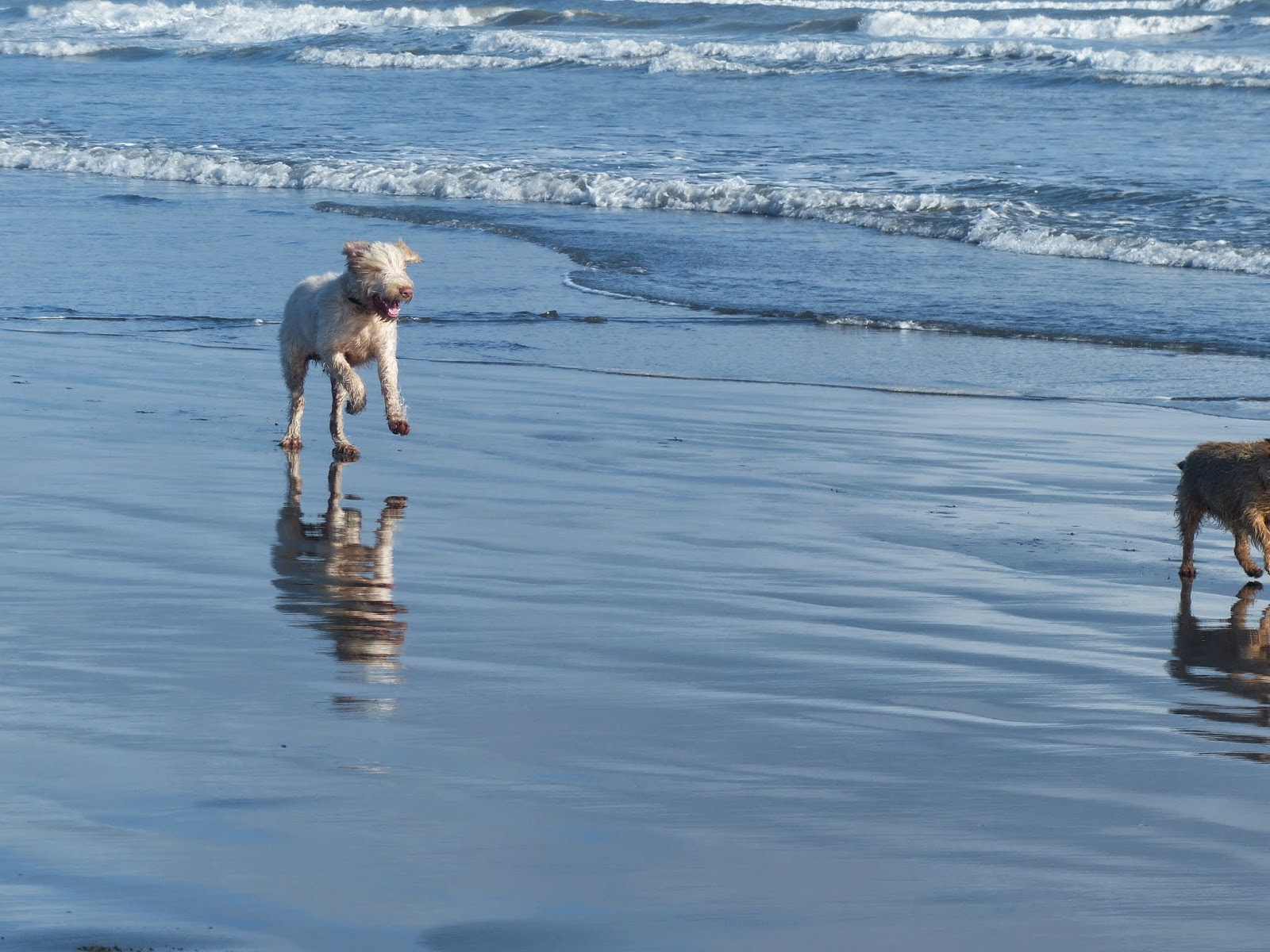
The dogs had the time of their lives.

As did the girls.


We played in the sand dunes.


And ran in the sea (Harris is teaching Salvo to chase seagulls).


And came home again, happy and relaxed.


We live in a beautiful country, Aotearoa New Zealand - and all I needed, to remind me, was sea, sand, dogs and my girls, and the clear, sharp winter air.